Florida Considers New BUI Field Test After Wrongful Arrest
Governor Seeks To Curb FWC Boarding Powers
Florida Fish & Wildlife officers were taken aback last week when Governor Ron DeSantis proposed eliminating random vessel safety inspections without probable cause. For sure, stripping the state’s “mullet sheriffs” of their boarding powers would constitute a drastic change in marine law enforcement.
DeSantis cited the arrest of Michael Christian Arrieta, 36, of Jupiter, who was handcuffed and taken to jail last year for boating under the influence, even though a breathalyzer test later showed he had zero alcohol in his system.
“People who are just out enjoying themselves when there’s no indication that anything is wrong, they should not be subjected to these intensive searches,” DeSantis said during a visit to the Miami International Boat Show. He called the existing law “a wrong that has been an issue in this state for far too long.”
Arrieta, a self-described Christian capitalist and church deacon, was hauled away after failing a field sobriety test administered by Jared Stiltner, now the world’s most famous Fish & Wildlife officer. Body-cam video of the arrest went viral:
According to Stiltner, Arrieta failed three test components—the Finger to Nose Test, Palm Pat Test and Hand Coordination Test. Arrieta said that being in front of friends and family caused performance anxiety that prevented him from successfully following Stiltner’s complicated instructions (See test components below).1
A boater who witnessed the arrest from nearby told reporters that he had just taken the same field-sobriety challenge a few weeks earlier but with better results. “Heck, it was easier than the screening test they gave us at the Academy for flight school,” said retired Top Gun instructor Starbuck Jones, “but not by much.”
Yesterday, Fish & Wildlife Commission Chairman Rodney Barreto of Coral Gables proposed a compromise to the governor that would preserve his officers’ power to board recreational vessels while honoring what he called “the Free State of Florida vibe.”
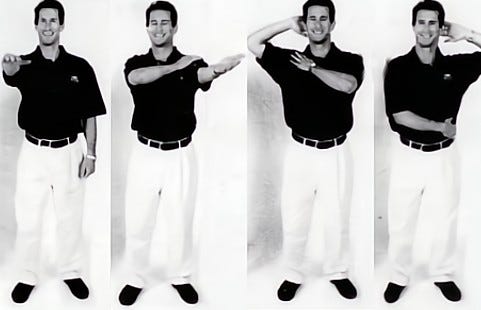
Barreto’s proposal would eliminate the three sobriety tests failed by Arrieta in favor of a single, fluid test procedure:
Right arm straight out, palm down. Repeat with left arm.
Turn right palm up. Repeat with left palm.
Bring right arm across chest. Repeat with left arm.
Put right arm across front of hips, touch left hip. Repeat with left arm on right hip.
Place right hand on right hip. Repeat with left hand.
Sway hips from side to side to the beat, repeat three times.
Jump, landing a quarter turn to the right.
Repeat.
Barreto said the test would be conducted to the tune of an upbeat song called “Macarena,” which would be played by Fish & Wildlife officers at the scene.2 An operator’s performance would be graded on a one-to-ten scale with one indicating totally wasted and ten indicating high school cheerleader.
The so-called Macarena moves would also be included on the curriculum for Florida’s Boating Safety Course, which is mandatory for all operators born after January 1, 1988.

“This new test procedure is not only more streamlined than what we now have, but it’s also a shout-out to Florida’s Hispanic heritage,” Barreto said, referring to the Spanish pop duo Los del Rio of “Macarena” fame.
“As a Puerto Rican, I appreciate this much needed reform” said Arrieta, founder and CEO of Garden City, a purpose-driven buyout holding company. “The next time I get caught speeding sober through a manatee zone, I’m confident that I could draw upon my cultural roots to ace the test. Boricua, baybee!”
Finger to Nose Test
In this test, the boater is asked to touch the tip of their nose with their index finger while keeping their eyes closed and head tilted back. Officers look for accuracy and coordination, which can be affected by alcohol or drugs. The procedure is as follows:
Step 1: The boater tilts their head back and closes their eyes.
Step 2: The officer instructs the boater to touch their nose with their left or right index finger in a specific sequence.
Step 3: The boater must accurately touch the tip of their nose with the correct finger.
Officers observe for signs of impairment such as missing the nose, using the wrong hand, or leaving the finger on the nose instead of returning it to the side.
Palm Pat Test
The palm pat test is unique to BUI investigations and is designed to assess a boater’s coordination and ability to follow instructions. Here’s how it works:
Step 1: The boater extends one hand, palm up.
Step 2: The other hand is placed palm down on top of the extended hand.
Step 3: The top hand pats the bottom hand, then rotates to pat with the back of the hand, increasing speed.
Step 4: The boater must count “1, 2” in rhythm with the patting.
Officers look for signs of impairment, such as difficulty maintaining rhythm or confusion in following instructions.
Hand Coordination Test
The hand coordination test is another exercise adapted specifically for BUI investigations. This test mimics the nine-step walk and turn exercise used in DUI investigations but is performed while seated. Here’s the procedure:
Step 1: The boater makes a fist with each hand, placing the left fist on the center of their chest and the right fist against the left.
Step 2: The boater moves their fists in a step-like fashion, counting “one” to “four.”
Step 3: The boater claps their hands three times.
Step 4: The boater then reverses the steps, counting “five” to “eight.”
Step 5: The boater places their hands on their lap.


Haha. Perfect
The best satire is nearly indistinguishable from the truth.