Flash! Bang! Growing Pyrotechnic Answer to the Orca Threat
Sailors Are Adopting an Illegal Tactic Because It Seems To Work

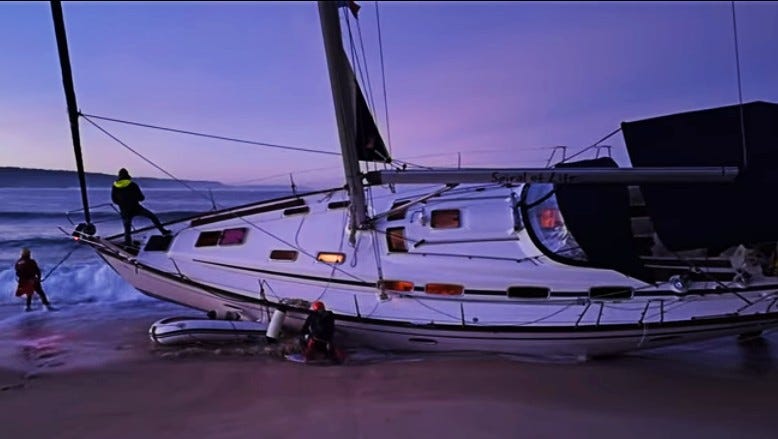
We’re not supposed to call ’em attacks because that, I guess, would be prejudicial. “Interactions” is better, we are told.
So, let’s just say it: Orcas are the ones that have been doing the interacting and with extreme prejudice, as they continue to ram sailboats off Iberia’s Atlantic coast. There have been a reported 700 of these non-attacks since 2020.
The latest interaction was a doozy. The headline-writer hadn't gotten the memo: “Scary Moment as 30 Killer Whales Attack Family’s Yacht.”
Can you imagine? Thirty of them!
Except, it’s likely untrue. Most of the Orca incidents have involved a half dozen or so of the animals, dubbed the “Gladiator Pod,” but six or seven is bad enough.
The headline-writer must have been including every orca in a 500-mile radius in that interaction, because there is no record of Michael and Laura of Spiral of Life Sailing (yes, a YouTube channel) asserting that number.
Gladiators have been credited with sinking six or seven vessels, but without killing or injuring any humans (after which must be added the obligatory) —yet. Most of the sinkings appear to have happened from heavy blows to spade rudders typical on modern cruising craft.
According to a December 30 article in the Independent, the Dutch couple was sailing between Porto and Lisbon “when their vessel was ‘violently’ buffeted by orcas at around 5 a.m.”
“I disengaged the autopilot and grabbed the wheel and then we got hit again. The hit ripped the wheel out of my hands for a moment,” Michael said in a video about the incident. “I grabbed it back as fast as I could, and then I heard it—right next to the boat—splashing and that heavy breathing you never forget once you’ve heard.”
(You can watch the episode below.)
Having heard that orcas prefer deep water, they steered the Bavaria 46 toward the Portuguese coast. In the terror and chaos of the moment, however, they forgot how close to shore they were to begin with. Spiral of Life ran up onto the beach and flopped on her side, having been herded aground by swimming animals said to have the thought processing abilities of a human ninth-grader.
With the help of locals, Michael and Laura were able to recover their boat and are having repairs made.
Boom! Just Like That
Meanwhile, a growing number of European sailors are adopting what you might say are teenage tactics to deal with a teenage threat. They are throwing firecrackers at the whales—the kind that will explode underwater.
Think 1943: Destroyers versus Uboats.
As EuropaSur has reported:
Frequent orca attacks in the Strait of Gibraltar and the Gulf of Cádiz have led to a surge in sales of water fireworks in shops like those in Algeciras, despite the fact that it is forbidden to carry them and even more so to use them to scare away these or other marine animals.
Consumer fireworks are generally illegal in Portugal, so cruisers are stocking up in the Galicia region of Spain in the north or Andalusia in the south. Petardos, as they are called, are even sold at nautical chandleries.1
Confronted by orcas, sailors have tried dumping sand or diesel fuel, activating pingers or motoring in reverse. No joy.
According to yet another YouTube sailor, a sensible sounding guy who goes by the handle Reversing Entropy, fireworks are the only “anectdotally proven” countermeasure.2
Every report you hear about people using this, you know, mouth to mouth, people are not putting this on the internet because, you know, it’s illegal. But everyone’s story seems to end the same way. They deploy the firecracker inside of the water and the orcas just swim away.
We don’t want to hurt them. We don’t want anything bad to happen to them. We just want them not to sink our boat. This practice seems to be so effective that I hear from reliable sources that you can now buy in Spain in chandleries a kit that comes with the firecrackers and a big pole. You attach the firecracker to the front of the pole and you immerse them into water, let it explode, and then, you know, get it back.
As it happens, orcas are extremely sensitive to sound and rely on it for hunting, communication and navigation using echolocation. And sound travels very efficiently underwater.
A January 19 story in the U.K.’s Daily Mail quoted a study of the orca pod in question (lead by a female that scientists call White Gladys), which noted that the Gladiator Pod is an unusually quiet bunch:
Orca pods are typically very vocal, especially when they are hunting or playing, but White Gladis and her team pulled apart stranded yachts in eerie silence.
However, scientists have now discovered that this is merely a tactical choice. Like most pods, the orcas that live around Ibera and the Strait of Gibraltar specialise in hunting a single type of prey.
Because these killer whales are experts in tackling the alert and flighty tuna, they have learned to hunt in silence and avoid any noise that might startle the fish.
Naturally, the depth-charging of whales is driving environmentalists and animal rights groups crazy. Some sailors are against it, too, arguing that Gladys and crew will treat it as an escalation and respond by increasing the ferocity of their interactions.
Which is giving orcas a lot of credit, but hey…who knows?
“All you firecracker supporters are doing is making the attacks increasingly ferocious, and you'll be justifying the use of more powerful explosives. Sadly, it's already happening,” a Norwegian sailor wrote on an online forum.
Did he say attacks?
PLEASE SUPPORT THIS NEWSLETTER BY DRINKING HEAVILY. CLICK ON STORY TO ORDER WITH FREE SHIPPING.

As in: “Hoisted by his own petard.”
Having been “killed” in a mortar attack (in training with military flash-bangs), I can attest to the disorientation and fear that these can induce in a human being.
There's also no way firecrackers would be an option in the PacNW because the USN and USCG ships that ply these waters would know and come down on offenders like a ton of bricks.
Everyone on the Salish Sea in the Pacific Northwest is just crossing our fingers that this behavior doesn't cross pods and expand out from Iberia. It would heartbreaking and dangerous for all involved if the Puget Sound and nearby pods adopted this behavior.