


The author is a retired naval architect. This is the seventh of an 11-part series explaining stability to a lay audience. Links to the previous installments can be found below.
Meta what?
Paraphrasing Wikipedia’s head-spinning definition:
Meta comes from the Greek µet? = "after," "beyond," "with," "adjacent," "self." In English, meta is a prefix used to indicate a concept which is an abstraction from another concept, used to complete or add to the latter
Exactly. Meta is an abstraction.
It doesn't represent any force or center of forces and yet it is very useful when analyzing the stability of a ship. Read some popular texts on stability and you would think that the Metacenter is the most important concept in stability. It's actually about the last thing you want to focus on if you are trying to understand what is going on.
Anyway, here's the scoop on it:
Remember how the first part of the righting-arm curve is a straight line? The triangles of hull cross section being lifted out on one side and immersed on the other cause the center of buoyancy to move in a simple relationship with the heel angle as the shape of the hole the boat makes in the water changes. The righting arm at six degrees will be twice as much as the righting arm at three degrees. This creates a simple geometric relationship.
Watch the Center of Buoyancy move as this boat heel back and forth:
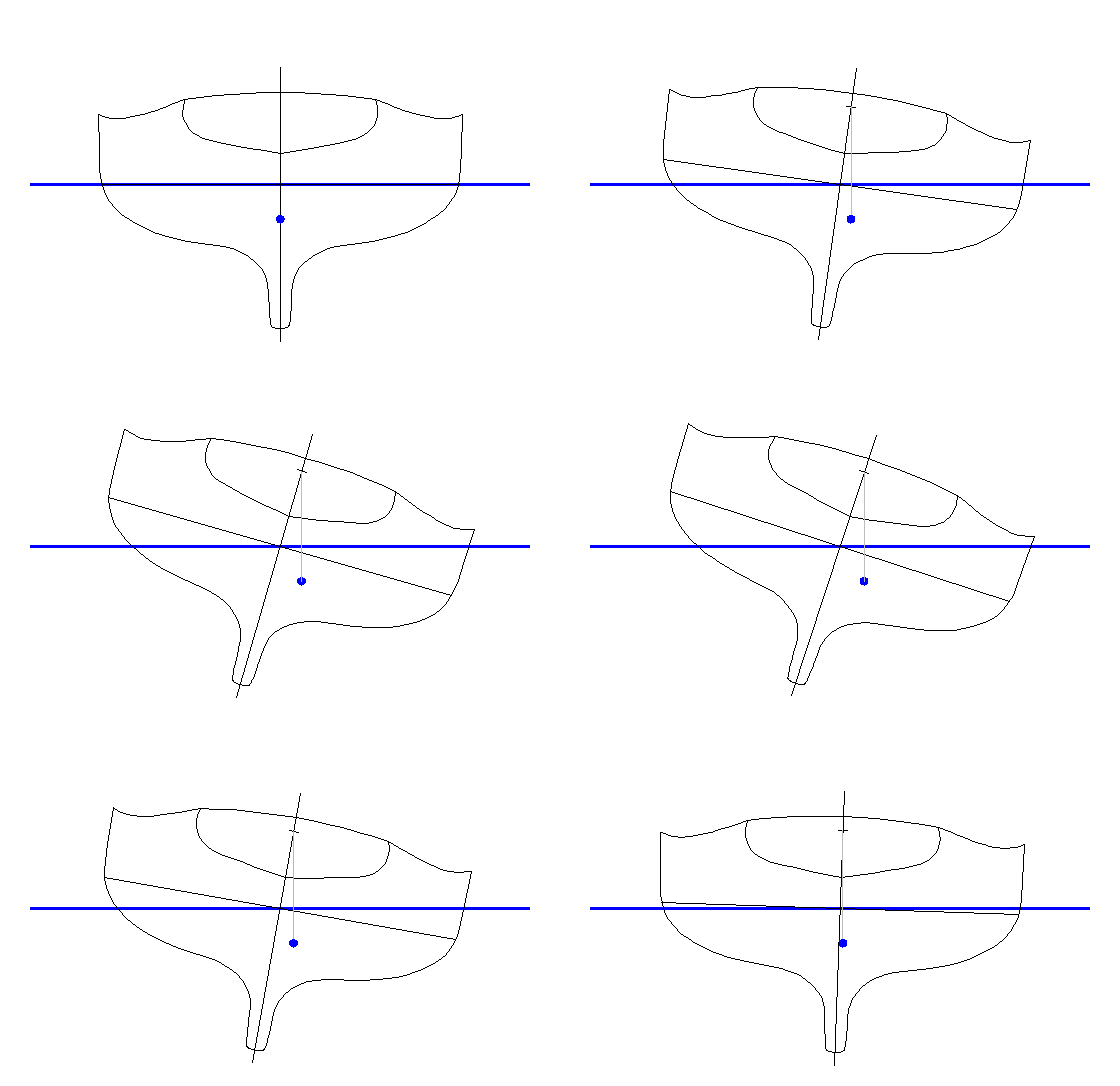
Note that it shifts the same amount with each equal increment of heel angle. If you draw a line vertically upwards from the CB therefore, it will always intersect the centerline at the same point. This is the (drum roll) Metacenter.
Why is the Metacenter talked about so much when it doesn't directly represent any real forces? To locate the CB of the heeled vessel, you have to perform complex calculations on the underwater shape of the hull.
Doing this for every two or three degrees of heel angle was especially laborious back in the days when slide rules and pads of paper were the state of the art computational instruments. It turns out that the Metacenter can be found with some relatively simple calculations.
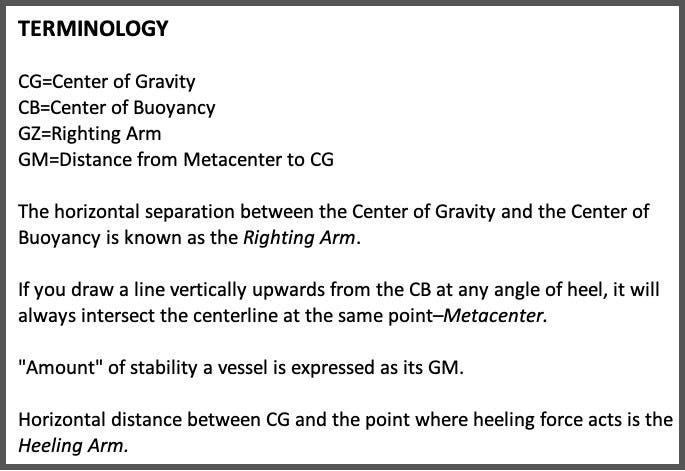
Once you have located the Metacenter, you can put any calculated or known Center of Gravity position on the plan and simple trigonometry will give you the righting arm for any heel angle. The distance from the Metacenter to the CG is the GM you hear so much about. Know GM and the heel angle and you know the GZ a.k.a. Righting Arm.
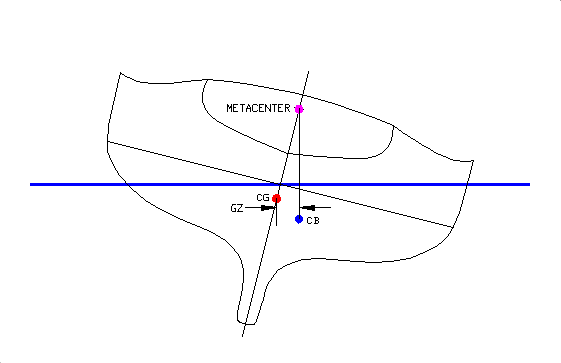
The higher the CG the shorter the Righting Arm will be at any particular heel angle and lowering CG, say by lightening the rig and adding an equal amount of ballast, will increase GZ. This simple relationship falls apart as soon as the deck goes under water but it covers most normal operating conditions.
This is why you will so often hear the "amount" of stability a vessel has expressed as its GM. When you are talking about vessels of similar type and displacement saying, "High GM and low GM" is the same as saying "High stability and low stability" for heel angles up to the angle of deck edge immersion.
For all except vessel whose sides are perfectly vertical all the way around, the GZ found by applying trig to the GM and heel angle will be an approximation but it's close enough for most work. The more flare and longer ends a vessel has, the more the actual GZ will be underestimated but this builds in a small safety factor so it is generally ignored.
If you read advanced texts on naval architecture, you will occasionally see references to Metacenter location at angles beyond deck-edge immersion, but I have not once in four decades of practice seen an occasion where the concept was actually used.
Another thing that make the metacentric GM view of stability so useful is its relationship to rolling period. If you look at the animation above, the CB seems to hang below the Metacenter like a pendulum. Just as a pendulum has a single specific period at which it will swing naturally, so does a boat. Like a pendulum, the natural rolling period of a boat is a function of the GM. The longer the GM, the faster the boat will roll.
This is why boats with low stability and minimum sail carrying power are often comfortable sea boats. Back when I was doing a lot of stability tests on fishing vessels for insurance reasons, I would often have fishermen say to me before the test, "This boat couldn't possibly have a stability problem, she hardly rolls at all."
I would then know that I was probably going to be giving him some very bad news. As you reduce GM in a power vessel of traditional hull form like most fishing draggers, it just gets more and more comfortable until it lays down in the water and dies. After all, the slowest roll of all is one where the boat just goes over and doesn't come back.
In case you missed it, Roger Long recently dispelled misinformation about the sinking of a Miami motoryacht bearing a bevy of bikini-clad “influencers.”
The rolling period of a boat is also affected by how the mass is distributed out from the center. Have two people sit on the centerline of a small boat and measure the rolling period. Then have them move out to the rails. The rolling period will slow even though GM has not changed. If you have two similar vessels and know the rolling period and GM of one, you can then simply start the second one rolling by pushing on its rails. About 10 seconds of calculator-key punching later you will have a fairly accurate measurement of GM and quickly be able to calculate righting arms for angles up to deck edge immersion.
The effect of mass distribution can be predicted with good accuracy by applying a factor to the vessel's beam so the rolling period method can even be used for vessels of different size as long as they are of similar configuration. One of the things in my data files is a collection of these beam factors, known as "Rolling Constants" for different types of boats so that rolling period can be predicted at the design stage.
Sailboats tend to have low rolling constants due to the mass spread out from the center by their rigs and ballast. If you have ever motored you sailboat to or from the shipyard with the mast removed and noticed how quick and jerky her motion is, you've seen the effect of rolling constant and increased GM.
Next, Part 8: Balance of Forces. “If the vessel is upright, it initially has no resistance to being heeled a tiny amount.”
EARLIER


Kudos to Roger Long for demystifying the term "metacenter", which I've long regarded to be conceptually opaque as a model and an impediment to understanding stability. Cheers!
As someone new to these concepts, the Metacenter/GZ/CB diagram was hard to understand and having read other references (e.g. here [https://www.maritime.org/doc/dc/part2.php]) I now believe that it's both incomplete and incorrect (perhaps for reason of editorial version, say. I don't imagine that Roger doesn't know this stuff.)
Here are the changes I made to reflect my current understanding (with a redrawn pic to illustrate at [https://imgur.com/a/gFn6uj8]):
* GM and GZ being lines whose length matters, I redrew them with arrows on, and removed confusing labeling arrows.
* Recoloured CB turquoise to make the GM line termination easier to see.
* Added a GM label to the Metacenter/CB line
* Added an angle marker beneath Metacenter for clarity in description;
* Added a horizontal GZ line from CG and normal to the GM line.
* Removed the little line below CG going down to the height of CB as irrelevant -- it was perhaps intended to be drawn horizontally in the first place.
If my understanding is correct, then here's how that would operate:
1. As the vessel straightens, the Metacenter/CB line GM will tend to approach the Metacenter/CG line, closing the marked angle.
2. The righting arm GZ which makes up the third side of the triangle will consequently shorten -- meaning that there is almost no resistance to heeling when the vessel is flat and its mast stands vertically.
But as the vessel begins to heel right, as shown, the same angle opens and GZ lengthens, up to point where the deck goes below the water. Over this range, the righting arm grows stronger.
(Mathy bit for those who like such things: The triangle produced by GM and GZ is a right-angle. Because the length of Metacenter/CG is known and the angle of heel determines the angle of the Metacentre/CG line off vertical by a simple calculation, a bit of trigonometry can also produce the length of GZ, per Roger's explanation. I believe I could produce that trig if poked.)
Could someone who studied this stuff please check it and correct me if I have it wrong? I think Roger is not reading comments.
(Peter, you are invited to check with Roger, and are welcome to update the article with my altered diagram if you both think it appropriate.)