


The author is a retired naval architect. He once testified as an expert witness in a case involving a ship that capsized and sank. This is the third of an 11-part series explaining stability to a lay audience.
The useful fiction that displaced water creates an upwards force inside its volume becomes even more valuable when we try to figure where that upwards force is acting. The pressure of the water is always acting perpendicular to the surface of the hull.
If you visualize the curved surfaces of a typical boat or ship, and then remember that the pressure is different at every depth, you'll see that there are an almost infinite number of pressure quantities and directions that would need to be all summed up in order to directly calculate the amount of the upwards force.


It is indeed a fortunate thing that volume equivalency works so well. Now add the need to figure out the point that corresponds to the imaginary point where gravity seems to act and the job of calculating all those pressure force vectors becomes even more unmanageable.
We need to know the location of the Center of Buoyancy, CB, for the same reason we need to know the Center of Gravity. It is just too complex to deal with each unit of displaced volume individually, even after adopting the simplifying fiction that it is the volume which is generating the upwards force.
The buoyancy will act as if it is pushing up through a single point exactly as gravity acts as if it is pulling down. One magic string up and one magic string down.
It is actually quite a bit easier to calculate the CB than the CG at the design stage. Instead of vast tabulations of every item in the vessel and their locations, you only need to make some calculations of the shape of the underwater hull. The calculations are conceptually more complex but there are far, far, fewer of them. Instead of a phone book sized document, you need only a single page worksheet if doing it by hand.
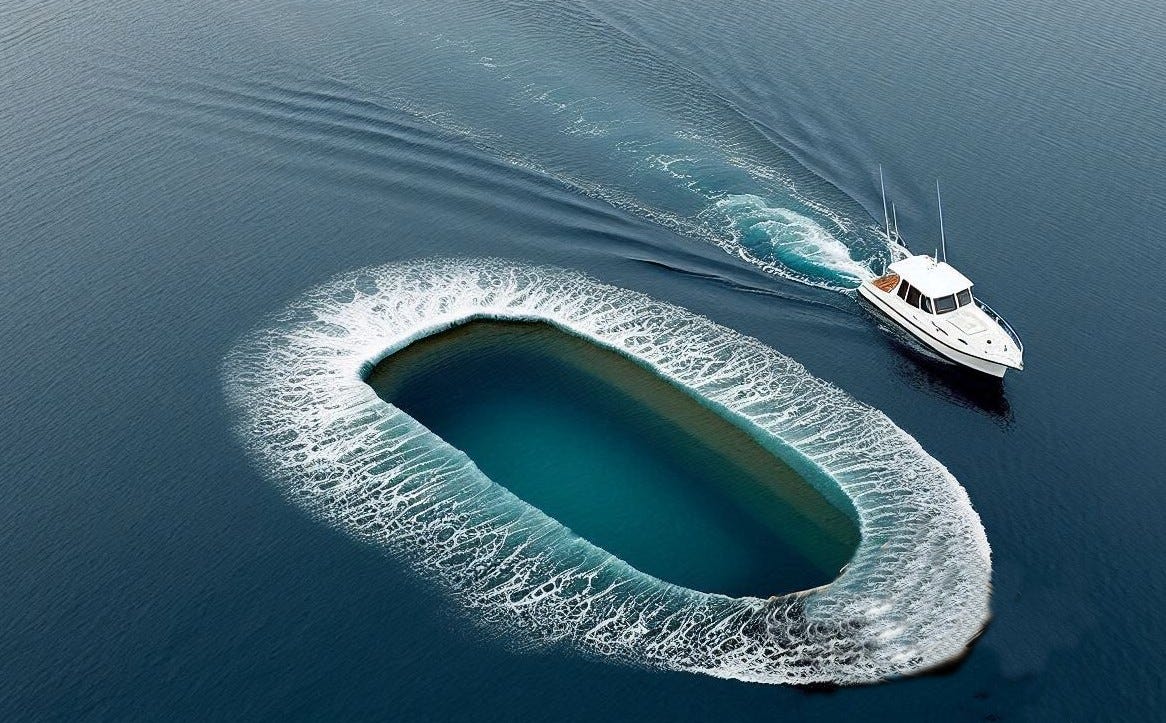
In order to be able to understand stability at the gut level, you need to be able to form a clear mental visualization of the hole that the boat makes in the water. A good way to do this is to imagine the water being frozen solid and a crane lifting out the boat. This leaves a hole. Now fill the hole level with the surface with something of uniform density like wax or concrete and lift it up in the air. You will have a solid object the shape of the hole the boat makes in the water.
The center of buoyancy will be at the center of gravity of this shape.
This is the key point, the big enchilada of stability. The CG of this shape, the Center of Buoyancy, will have both a fore and aft and a vertical location. If the boat wasn't built carefully and the two sides are different, it may also be slightly off the centerline but we'll assume proper boatbuilding for the remainder of this discussion.
Why is the CB important? Well, one thing we can be sure of when we see a boat sitting quietly in still water is that the center of gravity is directly in line, vertically, with the center of buoyancy. If you have two forces acting in opposite directions and not in line, something has to give.
The offset produces rotation and the boat will therefore heel or pitch until the two centers are again aligned, if they can be. If they can't, there will be bottom paint drying in the sunlight. If you want a boat you are designing to end up floating so that the boot top is parallel with the water, you have to predict where both the CG and CB will be as well as making sure that the structural and other weights will correspond to the weight of the displaced water.
Next, Part 4: What’s Upsetting? “Stability is the ability to resist an upsetting or heeling force.”

Love this series. Not to complicate things further, but isn't what's really going on that the water is exerting a force normal to the wetted surface of the boat, variable with the depth, and because statically boats are balanced in the abeam and ahead/astern directions, we're choosing to just talk about the vertical component? Is there any situation where this simplification causes us trouble? Dynamic behavior of the boat in high seas, perhaps?
Thank you Roger for posting. This one pinged for me in interesting ways.
I've been training in whitewater kayaking and have lately been learning to kayak-roll. That's not something you'd ever want to do in a sailboat, but you need to do in white-water and sea-kayaks for safety and to restore stability -- it's not a stunt, but a legitimate and frequent emergency maneuver that might occur a handful of times on some trips. You want to develop a 'bombproof' roll, which is all about managing CG vs CB.
The part that pinged for me here is that the wetted hull-shape of a rolling kayak doesn't only change just a bit -- it changes in about every way that it can through the axis of rotation.
So how easy it is to roll a kayak depends very much on its cross-sectional shape. A roll in a narrow sea kayak is easy to initiate, but harder to stabilise. In a wider creek-boat like the one I'm training on it's not hard to initiate, but you really have to force it through the roll because it wants to stay inverted and the way you force it through isn't with the paddle so much as by snapping your hips, which, not being a Turkish belly-dancer, I have struggled with.
Furthermore, it's counter-intuitive because you're using your body to roll the kayak back up -- your head is literally the last thing that you want to stabilise because it's much easier to move the CG when your body's outside the kayak than inside it. Your head literally comes up from the water last -- think of it as stabilising the hull first, and then raising the mast. But that's not what you want to do of course -- your head is your lung-snorkel, and wants to come up first.
If you ever want the repeated experience of drowning upside-down, try learning kayak rolls in a creek-boat in murky river-water week after week. You'll suffer serial trauma while trying to work out something no human was ever meant to do. Absent external help, it's an all-or-nothing skill -- you either get it right, or you're pulling off your spray-skirt and swimming out of a capsized boat, heart hammering, to empty the boat out and try again.
But what cracked it for me was to add a float to the end of my paddle. These are bags you can inflate to help you get back into a kayak, noting that kayaks have virtually no freeboard. But stick one on the end of your paddle and it adds buoyancy for virtually no change to CG and moves the CB far outside the hull. Suddenly the kayak wants to self-right and you just have to practice the motions, gradually deflate the bag and you can learn the skill incrementally rather than in a sudden-death situation.
In the end, you're using a hip-snap to roll the kayak with the paddle to stabilise it as a temporary outrigger. You get the kayak over, then your torso and head. That's the theory anyway.
Then you just have to learn to do it in fast swirling flow, amid foam, while tired, with oncoming rocks trying to brain you.