


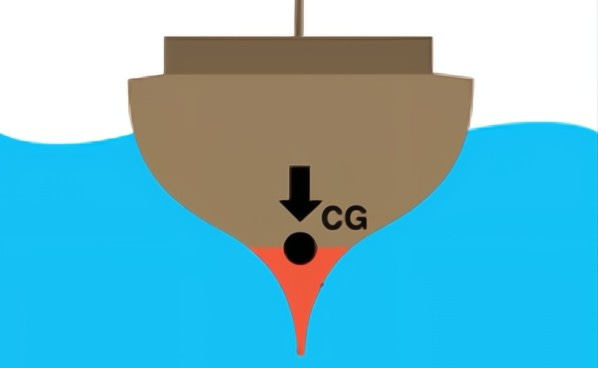
The author is a retired naval architect. This is the second of an 11-part series explaining stability to a lay audience.
Center of Gravity is another imaginary concept. It's a fairly easy idea to grasp, "Oh, yeah, it's the balance point." However, it's worth exploring in a little more detail to help understand some things that come later.

If you have a simple shape of uniform density, like a length of 2 x 4 lumber, it's easy to find the center of gravity. It's in the middle. Measure to the middle with a ruler and that is where the board will balance.
Now drill a hole in the end and insert a chunk of lead and it becomes more complicated. The board will balance closer to the additional weight. The center of gravity has moved.
There is a very simple calculation to find the new center of gravity if you know the CG (Center of Gravity) location and weight of the board and the lead. The calculation may be simple, but, when you design a ship or boat and have to predict the center of gravity location, you end up with a city-telephone-book-thick document of these simple calculations as you account for every one of the thousands of items a vessel contains.
CG is in the same position regardless of the orientation of the object. Put a screw eye in the exact middle of the end of our unweighted 2 x 4 and it will hang straight down in the air. If you drill the hole and insert the lead off to one side of the board, it will no longer hang straight down.
When designing ships and boats, it is necessary to predict the CG both in the fore and aft direction and up and down. For asymmetric vessels, it also has to be calculated from port to starboard to figure out how much stuff needs to be installed on the side opposite the deckhouse.
If you attach a string to any point on any object in the universe that doesn't have moving parts or contain liquid, the object will hang in air below the string in such a way that an imaginary extension of the string runs through the center of gravity. This only tells you the line that the CG is located on.
Attach the string to another point, and the imaginary line will intersect the first one at the CG. Every possible line projected from every possible string attachment point will run through this single point, the center of gravity.
The converse of this is that the object will always behave as if gravity were acting on it by pulling down from this point.
Visualize an imaginary magic string connected to the CG. This string can move freely through the object but is always pulling the object towards the center of the earth with a force equal to its weight. There is nothing special about the point where this imaginary string attaches. It is simply the mathematical sum of the gravitational attraction of all the infinitely small particles of the object to the earth.
Since it is cumbersome and impractical to talk about all the small pieces of something like a ship individually, we make up this point called the CG and pretend that pull of the earth acts on it alone. It's much simpler and, for most calculations and purposes, the answers come out exactly the same, just as when we pretend that the volume displaced by water creates an upwards force instead of trying to deal with the sum of all the individual units of pressure on the surface.
Anyone who has ever gone fast around a corner in a car knows that the the "down" of gravity can be changed by overall motion of the object. The same thing happens when boats are moved by the motion of waves. When "down" is changed by outside motion, the CG will seem to be pulled in that new direction. This is beyond the scope of the present discussion, however. We will keep this to motionless boats floating in still water until we fully understand the basics.
Next, Part 3: The Imaginary Center of the Imaginary. “In order to be able to understand stability at the gut level, you need to be able to form a clear mental visualization of the hole that the boat makes in the water.”

Then we have the Centre of Buoyancy, to calculate, followed by the dreaded Metacentre and the metacentric height! When I was a ship's officer (UK Merchant Marine) these had to be calculated virtually every day - use of fuel, water stores etc, plus of course everytime something is discharged or loaded! free surface effect of partly filled tanks etc etc etc. All done on paper - no computers to help, draft and trim checked all the time etc etc. The cunning plan was to have a negative metacentric height of around 1 -2 feet, so when the ship rolled, the box shape would dramatically move the centre of buoyancy to give a positive righting moment. On a ship you don't want it to be too stiff! If it is the rolling becomes violent and dangerous! Try motoring a sailing yacht, without its mast up, in rough water and you will discover this effect!
In my office I have a “reproduction” painting of the sv/Samuel Plimsoll. Give him credit for saving ships from overloading the freight mass and endangering the metacentric height taking into account even the density and temperature of the water. Even then it doesn’t address the placement of the freight which greatly affects the CG and overall stability.